shortDOI is a URL shortening service that takes DOIs and converts them to short URLs such as http://doi.org/bb6, which is nice for emails and Twitter. You can add the bookmarklet by dragging this link to your bookmarks: shortDOI. It will try to find the DOI in the current page and direct you to shortDOI.
A shortDOI URL is probably more persistent than, say, bit.ly, as it's backed by the organization that maintains the DOI infrastructure. However, if doi.org would go down, you could always use a search engine if you have the original DOI, but the shortDOI URL will be worthless.
Update 24.02.2011: Use some majority voting to find the right DOI.
Update 01.03.2011: Expand the list of allowed characters. Does anybody know which characters can be part of the DOI?
Update 29.07.2015: Be strict about having a prefix and suffix. First check for the "citation_doi" meta tag before looking in the rest of the document.
Wednesday, February 23, 2011

Monday, February 21, 2011
Why should we apply Moore's Law to DNA sequencing?
In this chart of cost per megabase of DNA sequence, an extrapolation based on Moore's Law has been added. What's wrong with this? It starts in 2001, the year of the human genome.

In 2001, only few animal genomes had been published (starting with worm in 1998). If I had to compare the human genome to a computer, I'd pick ENIAC. Moore's Law, however, was stated in 1965, some 20 years after the first "real" (i.e. Turing-complete) computers like the Zuse Z3 or ENIAC. When you go back, Moore's law doesn't hold anymore:
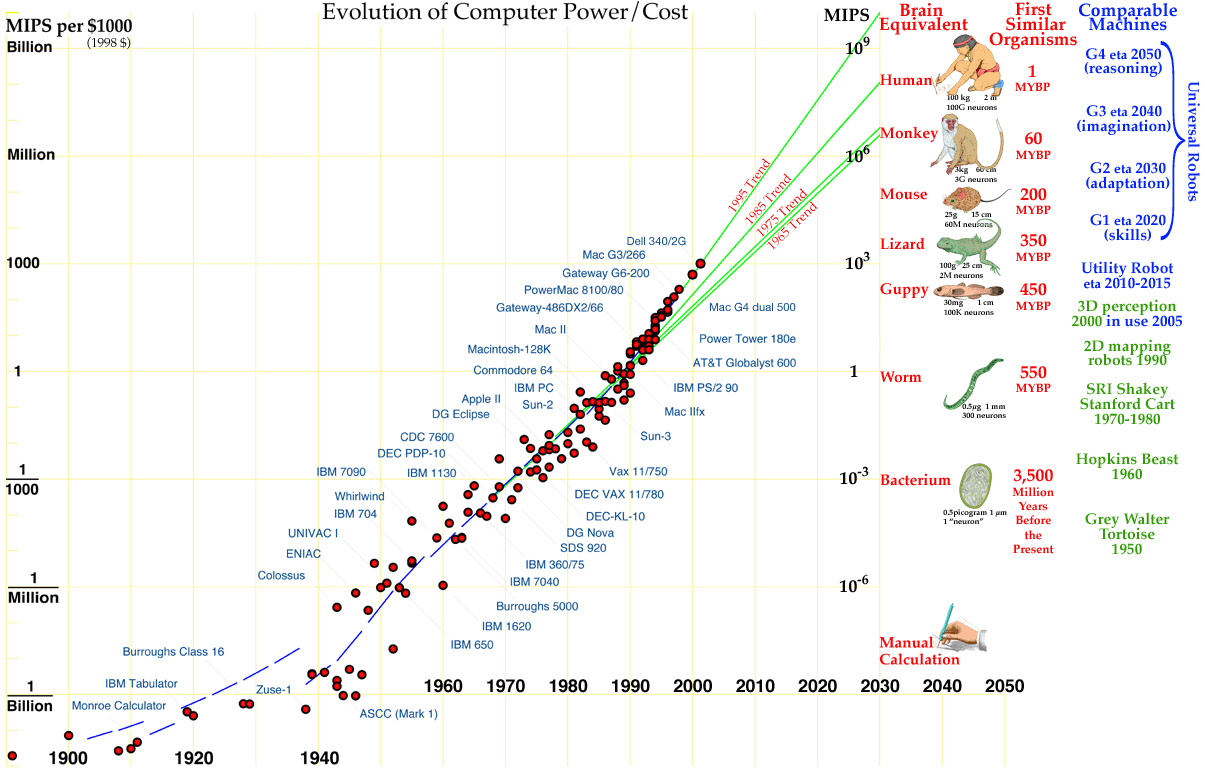 |
| Source: Hans Moravec |
With which rate will DNA sequencing progress? Perhaps the sharp decrease in sequencing costs between 2008 and 2010 is comparable to the transition from vacuum tubes to transistors, and Moore's Law will be followed from now on (extrapolating from three data points...). But perhaps we'll see more sharp decreases, and should overcome the desire to extrapolate using Moore's Law from arbitrary starting points.
(HT Deepak.)
Wednesday, January 19, 2011
New repo: local NCBI taxonomy database
I added some new functionality to the taxonomy repository at Google Code, creating a fork at BitBucket. The existing Python package already makes it possible to create a local database containing the content of the NCBI taxonomy, which can then be queried for names, ranks, and lineages. I added functionality to create a Newick tree from a list of NCBI taxonomy identifiers.
Thursday, September 16, 2010
Linking a remote command line and the clipboard
Being logged in to a server via ssh and iTerm, I sometimes want to get the result of a remote command to the local clipboard. The commands pbcopy and pbpaste do this for the local machine, but don't work remotely. However, it's possible to ssh back to you machine (if no firewalls interfere) and invoke these commands:
alias pbcopy "ssh `echo $SSH_CLIENT | cut -f 1 -d ' '` pbcopy"
alias pbpaste "ssh `echo $SSH_CLIENT | cut -f 1 -d ' '` pbpaste"
Of course this is only convenient if you have ssh key authentication set up.
Friday, August 27, 2010
Convert Stockholm sequence format to Fasta
The original stockholm2fasta.pl didn't preserve the order of sequences. I fixed it to preserve the order:
Thursday, August 19, 2010
Evolvability and the rate-limiting step
Do complex cellular processes (like the cell cycle) have a single rate-limiting step? (I.e., do they follow the Arrhenius equation?) Intuitively, this seems to be the case, as there should be one reaction that is the slowest (and thus rate-limiting).
Now, from the point of fitness, it would make sense to have all reactions occur at the same speed (e.g. by tuning enzymes levels). This would mean that there is not a single rate-limiting step, but rather a series of equally fast steps. Assuming that mutations are more likely to influence protein expression than to increase the catalytic activity of enzymes, this "balanced state" could actually occur.
However, once all reactions are tuned to be equally fast, how do you evolve? If there's only one slow reaction, clearly you have selection pressure on this reaction. If all reactions are equally fast, making one of them even faster (by changing the enzyme's activity) would have no influence, no?
Perhaps a way out is that after the enzyme's catalytic activity has increased, lower levels of this enzyme suffice, thus increasing fitness.
Now, from the point of fitness, it would make sense to have all reactions occur at the same speed (e.g. by tuning enzymes levels). This would mean that there is not a single rate-limiting step, but rather a series of equally fast steps. Assuming that mutations are more likely to influence protein expression than to increase the catalytic activity of enzymes, this "balanced state" could actually occur.
However, once all reactions are tuned to be equally fast, how do you evolve? If there's only one slow reaction, clearly you have selection pressure on this reaction. If all reactions are equally fast, making one of them even faster (by changing the enzyme's activity) would have no influence, no?
Perhaps a way out is that after the enzyme's catalytic activity has increased, lower levels of this enzyme suffice, thus increasing fitness.
Thursday, July 1, 2010
Makefiles and concurrency
Makefiles offer an option for parallel execution, but there is a stumbling block: it is possible to create race conditions that can lead to corrupt output files if two Makefiles want to make the same target.
For example:
Makefile:
Makefile.b:
When run single-threaded, the file x just contains 'A'. However, in multi-threaded mode, it will contain both lines: 'B' and 'A'. So there is no "stack" of commands to be executed that gets checked for duplicated commands to make the same file. Hence, files that are prerequisites for the parallel parts need to be made first.
For example:
Makefile:
all: a b

a:
        $(MAKE) -f Makefile.a

b:
        $(MAKE) -f Makefile.b
Makefile.a:
a: x
        echo A
        cat x > a

x:
        echo A makes X!
        sleep 3
        echo 'A' >> x
Makefile.b:
b: x
        echo B
        cat x > b

x:
        echo B makes X!
        sleep 2
        echo 'B' >> x
When run single-threaded, the file x just contains 'A'. However, in multi-threaded mode, it will contain both lines: 'B' and 'A'. So there is no "stack" of commands to be executed that gets checked for duplicated commands to make the same file. Hence, files that are prerequisites for the parallel parts need to be made first.
Subscribe to:
Posts (Atom)